Rhodes Clav Pro Plugin

Rhodes Clav Pro Plugin

Introduction

Following hot on the heels of their Wurlitzer release, Rhodes have added to their range of ‘electro-acoustic’ plugin instruments with the release of the Clav Pro. Thank-you so much to Rhodes for sending me a copy to play with!

Clavinets were first introduced by Hohner in 1964, modelled on that popular 14th ceuntury practise instrument, the Clavichord.

They really came to prominence in the early 70s, when artists like Stevie Wonder added a touch of overdrive, a phaser, a wah pedal. Superstition was released in 1972 and suddenly Clav’s became became part of the funk canon. By the mid 70s, they were adopted by Billy Preston, EWF, Herbie Hancock, Parliament / Funkadelic and many others.

Overview

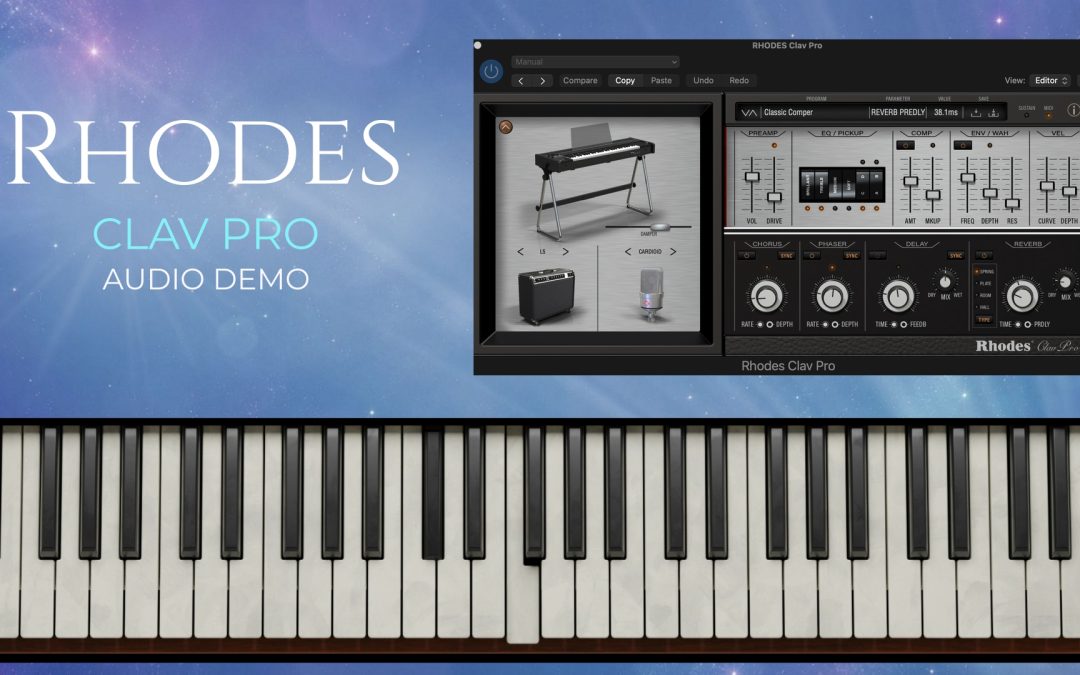
The Rhodes Clav Pro plugin looks to be primarily modelled on the less-common Hohner E7 and is laid out in that now familiar Rhodes way, with the instrument image, mic and speaker cab options on the left and the effects on the right. This particular plugin offers a Preamp, EQ via Pickup settings, a compressor, envelope/wah filter and velocity controls across the top, with Chorus, Phaser, Delay and Reverb being the primary effects across the bottom.

First Impressions

Even straight out of the box with no effects, I was instantly impressed by the clear tone and at how easily it can slot straight into a track. The sound has plenty of bite, that can be enhanced even further using the onboard preamp, compressor and velocity curve controls. Boost it even more with the pickup switches, which allow you to switch between softer and gritter tones.

Dial in some phaser and wah and you have instant funk.

Favourite Features

There’s a lot to play with in this plugin and it’s going to take a while to fully explore all of the features, with lots of scope for creating some unique tones. For this initial demo, I opted to create a Stevie-style riff

There are three amp choices (Duo, L5, JC) and two mic choices (Cardioid, Dynamic). I’m quite enjoying the L5 / Cardioid combo.

The damper slider in the same panel is a fun addition that cuts the sustain, giving a clippier, even funkier sound that’s great for comping.

A touch of Chorus and Phaser were added, along with a smattering of Reverb to give it a more 70s psychedelic vibe.

Final Verdict

For maximum funk, I’d recommend setting up with a Wah Wah or expression pedal and I’ll be playing with both options in future recordings.

This is going to be a fun plugin to fully explore and it will probably end up playing a part on quite a few future tracks.

You can get a two week trial demo at Rhodes – https://tinyurl.com/49wukdsb (aff link)
The Entropic Spacetime Field

The Entropic Spacetime Field

The Entropic Spacetime Field

After months of intense work, I’m happy to present my cosmological framework, The Entropic Spacetime Field (ESF). While it has been through various iterations during the research process, it became clear two months ago that the model required a wave equation.

Other versions of the equation were giving beautiful filaments or recreating Newtonian gravity, but no propagation. I kept returning to the wave idea because of this. But it was the discovery that Newtonian gravity could also be achieved that confirmed that it was the correct decision.

A Canonical Wave Framework For Cosmic Structure Formation

Today I have released the introductory paper on Zenodo DOI:21433778, which explains the framework in detail and outlines 7 benchmark tests and their results. Future research paths have been identified and are already being followed, including deriving all outstanding parameters. Lots of work still to do, but a very exciting start.

To stay updated on research progress, please join my newsletter. Signup form in the footer.

Finding The Mechanism

Finding The Mechanism

Finding The Mechanism

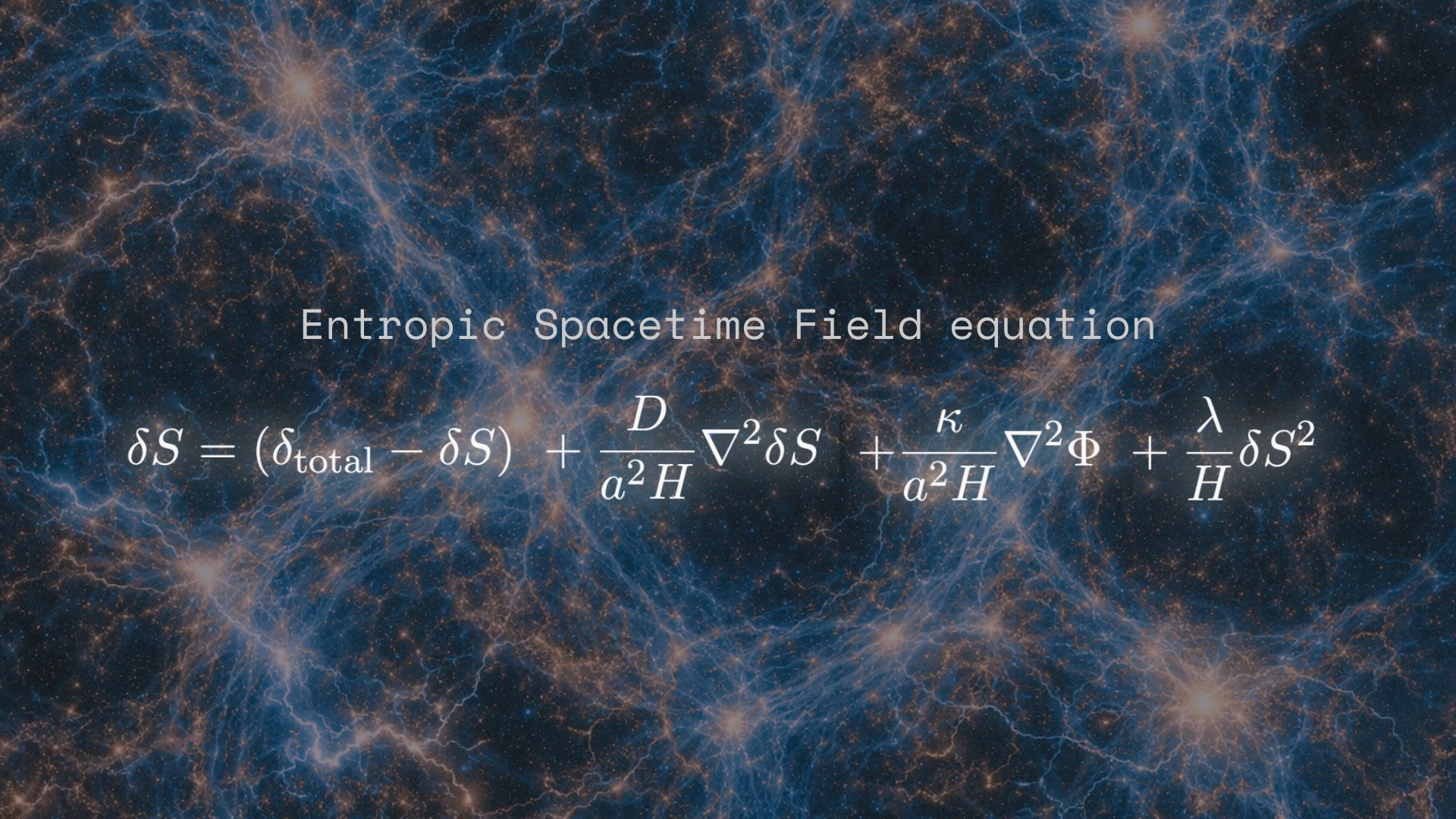
On International Women’s Day this year, I excitedly posted the Turing-style reaction-diffusion equation pictured here, that produced wonderful filaments in tests and looked promising in toy runs against other known tensions.

However, once I started digging down into the maths, it seemed that diffusion equations give beautiful Newtonian gravity but are not quite explaining the Ripplefield in other areas.

So for the past two months I’ve been running a series of tests on a new equation, which I’ll share once I have some definite results to post up. So far, it is displaying Newtonian  gravity and some flattening of rotation curves, but I’m digging a little deeper before reporting anything.

UPDATE: the above equation is from a legacy test, the canonical equation for ESF is a wave equation.

8 Favourite Virtual Pianos

8 Favourite Virtual Pianos

8 Favourite Virtual Pianos

Happy Piano Day 2025! I’ve played a lot of pianos over the years, real and virtual and I’ve had a few different favourites, depending on what project I was working on. These are the virtual ones that I currently have installed for various musical uses, including cinematic, jazz, relaxation and lofi.

IK Multimedia Pianoverse

I love the Pianoverse plugin and use these pianos on a lot of tracks, especially the Bösendorfer. I’ve always loved the rich tones of Bösendorfers, which makes them ideal for a range of styles, including jazz and chillout. There’s a lot of realism with Pianoverse samples due to their added mechanical noises, round robins and mic placements. I sometimes use this as a standalone for practise too. Lots of fun to play.
(Track – Desolation)

Modartt Pianoteq Studio

This is a fantastic plugin that I use for my daily practise as it loads really quickly as standalone software, I can be playing within seconds unlike some of the other options. I have a couple of Steinway D models here which are great for jazz (plus some vintage tines for the funk / fusion tracks).
(Track – Clouds)

EastWest Bösendorfer

EastWest Bösendorfer was one of the first virtual pianos I purchased due to its deep, rich tones. I’ve used it on a few relaxation tracks over the years and love the control that you get over the sound with the lid and mic position options. Dropping the lid gives a lovely, muted effect for very gentle, atmospheric pieces.
(Track – Rainfall)

Spitfire BBC Piano

I regularly use the Spitfire BBC orchestral instruments for soundtrack style pieces so getting the piano was a must as it blends beautifully with the room settings of the other instruments. It often needs a volume boost but has a lovely tone and expressiveness, as you would expect from such a high end sampling company like Spitfire.
(Track – Polka in Bb Major)

UJAM

I love all of the UJAM plugins, they take a different approach by offering a great, easy to use control panel with carefully matched effects and a range of preset tones and riffs for a really speedy workflow, hardly surprising since one of the founders is Hans Zimmer. Their Score piano is beautifully sampled, a very ethereal and atmospheric option.
(Track – Drifting Off)

Spitfire Labs Soft Piano

Spitfire Felt Piano is a Labs freebie and a fantastic choice for chilled out pieces. I’ve used it alone and blended with other pianos and it’s one of those instruments where, with the addition of a little bit of reverb, you can get lost for hours just playing for fun.
(Track – REM Sleep)

XLN Audio Addictive Keys

I have the Studio Grand which is a lovely, bright and dynamic option that’s a real pleasure to play. This one lends itself to different styles although I’ve mostly used it on cinematic and neo classical style pieces.
(Track – Sugar Lumps)

Korg M1

OK, so much more than a piano but the Korg M1 was a no brainer for recreating that classic house sound, so I picked this one up for sessions where that sound is required. It’s a lot of fun to play as it takes me back to that era where I first got into synths. I got to play on a real M1 every day in the store where I worked but never got to own one. Here’s a little sample of that famous M1 piano sound.

Rhodes Anthology Plug-in

Rhodes Anthology Plug-in

What an exciting time to be a Rhodes fan. Not only have we been treated to the new Model 8 plus its software version, the V8, Rhodes now have a brand new plug-in featuring some retro favourites.

Rhodes Anthology is released on 5th November 2024. The Leeds-based team have sampled four iconic instruments from different eras and added an effects section consisting of Preamp, EQ, Pan, Velocity, Chorus, Phaser, Delay and Reverb.

I was lucky enough to get my hands on a copy and have created a few demos to let you hear the different characteristics of each piano. The plug-in was fast to install and very user-friendly and features the great effects that we’ve been able to enjoy previously on the V8 plug-in. It’s easy to dial in a bell-like sound or that crunch that was so favoured by Jazz-Funk artists in the late 70s / early 80s.

More demos will be coming later featuring more of the effects plus the mic and cab options.

The V8 has been used heavily in my tracks since its release and no doubt the Anthology collection will be making a few appearances as they’ve really captured the essence of the original instruments. The Anthology platform leaves the way open for more models to be added in future, which I’m sure Dan at Rhodes will be looking into already, being such a huge fan himself.

The demos cycle through the four models in order so that you can hear each on the same track as a comparison – the Sparkletop, Mark 1, Mark V and Mark 7.

Rhodes Anthology - Sparkle Top
Rhodes Anthology - Mark 1
Rhodes Anthology - Mark V
Rhodes Anthology - Mark 7

14 Day Free Trial plus 30% Off Introductory Offer